Roomba Duo Is Two Robots in One: iRobot’s IFA Concept Sends a Mini Roomba Under Furniture
Robot vacuums keep getting taller, stronger and more complicated. iRobot’s newest idea takes the opposite approach: stop asking one machine to fit everywhere.
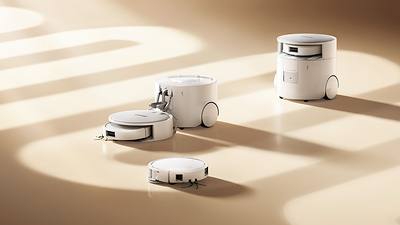
Unveiled at IFA 2026, the Roomba Duo pairs a heavy-duty vacuum-and-steam-mop robot with an ultra-compact companion that can be mechanically deployed into the low, narrow spaces the larger machine cannot reach. It is a prototype, not a product you can buy yet—but it may be one of the show’s more consequential cleaning concepts.
Why two robots instead of one?
The trade-off is physical. A larger machine has room for stronger floor-washing hardware, bigger batteries and water systems, but it struggles under low sofas and cabinets. A thin robot reaches those gaps but has less space for heavy-duty cleaning hardware.
Roomba Duo splits those jobs. The main robot handles open-floor vacuuming, steam pretreatment and roller mopping. When a tighter area needs attention, a top-mounted mechanical arm lowers the smaller robot, which then cleans beneath furniture and along edges using the same shared home map.
| Part | What it does |
|---|---|
| Main robot | Vacuuming, steam pretreatment, roller mopping and deep cleaning on open floors |
| Companion robot | Reaches beneath low furniture, around chair legs, edges and narrow spaces |
| AutoWash dock | Central clean/dirty water, mop washing and drying, and dust emptying |
The mini Roomba is only 8.35 cm tall
The companion shown at IFA is based on the Roomba Plus 575 Combo introduced earlier in 2026. iRobot lists it at 8.35 cm tall and 29.8 cm wide, with a PerfectEdge mop pad that can extend up to 31 mm and wheels designed to cross thresholds up to 3.5 cm.
The larger robot is built more like a floor washer
The main unit uses a 60 mm PowerSpin Max roller mop with a claimed 46 N—about 4.7 kg—of downward pressure. An internal heater generates controlled steam to loosen dried-on grime before the continuously cleaned roller passes over it, while hot air behind the roller is intended to reduce moisture left on wood floors.
Both robots use ClearView Pro dual-line LiDAR and PrecisionVision AI. The larger robot also adds elevated cameras intended to improve room mapping and identify larger stains or debris zones.
How the cleaning process is supposed to work
2. Divide — The main unit handles open areas while the compact robot is deployed for low-clearance zones.
3. Coordinate — The pair communicate through the Roomba Home app during the same cleaning mission.
4. Maintain — The shared AutoWash dock handles water, mop washing/drying and dust collection.
The important caveat: you cannot buy it yet
Roomba Duo is being demonstrated as a concept prototype at IFA 2026. iRobot has not announced a retail price, release date or final production specification. That distinction matters: the live prototype shows the architecture is more than a render, but it does not guarantee every demonstrated feature will reach a commercial model unchanged.
• Whether the mechanical deployment arm survives repeated real-world use
• How reliably two robots coordinate in cluttered homes
• Final dock footprint and maintenance requirements
• Steam compatibility with different flooring types
• Price: two robots plus a full-service dock could create a new premium tier
Why this concept matters
For years, robot-vacuum development has mostly meant packing more suction, taller sensors and more elaborate mopping hardware into one circular body. Roomba Duo proposes a different design logic: specialization.
If it reaches production, the more interesting shift may not be “two Roombas for one home.” It is the idea that domestic robots could become a coordinated team—different machines sharing the same map and dividing work according to their physical strengths.
Official references
iRobot — Roomba Duo announcement, Sept. 4, 2026
iRobot — Roomba Plus 575 Combo product information
The Verge — IFA 2026 coverage


댓글
댓글 쓰기